Video · 7 min read
Why your reels lose people at three seconds
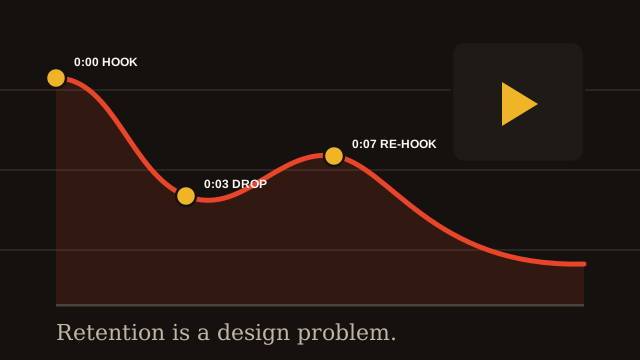
Almost every underperforming short-form video we are sent has the same shape: a strong first second, a cliff at three, and a long flat tail. That cliff is not a charisma problem. It is a structural one, and it is fixable in the edit.
What actually happens at three seconds
A viewer arrives with a single question running: is this worth my next ten seconds? Your first frame makes an implicit promise. By second three, they have enough information to judge whether the video is going to keep that promise — and if the answer is unclear, scrolling is free.
The mistake is treating the hook as the first line of dialogue. The hook is a contract, and most videos break it immediately by spending seconds two through six on context the viewer did not ask for. Introductions, logo stings and "so today I want to talk about" are all ways of telling someone the interesting part has not started yet.
Retention is not about being more energetic. It is about never letting the viewer wonder why they are still watching.
The hook map
Before we cut anything, we write four lines. This takes five minutes and does more for retention than any transition pack.
- The promise — what the viewer will get, stated or shown in second one.
- The proof — the moment that makes the promise credible, landing before second five.
- The re-hook — a new question or reveal placed exactly where interest would naturally dip.
- The payoff — the delivery of the original promise, not a call to action.
Then we cut to that map. If a shot does not serve one of those four things, it goes — regardless of how good it looks or how long it took to film.
Second zero: the promise
You have roughly one second. Some things that reliably work:
- Open on the result. Show the finished thing first, then explain how. Chronology is the enemy of retention.
- Start mid-sentence. Cut the first three words of the take. It creates the feeling of having walked in on something already happening.
- Make the first frame legible. If someone can understand the subject with sound off and no captions read, you have won the first beat.
- Put motion in frame one. A static talking head competes badly against movement in the feed.
- Be specific. "Three things I got wrong pricing this" beats "let's talk about pricing" every time.
One thing that consistently does not work: a branded intro animation. It delays the promise and tells the viewer that the next two seconds are safe to skip.
Second three: the re-hook
This is the part most editors skip entirely, and it is where the cliff lives. The re-hook is a deliberate second hook, placed where your analytics show the drop.
- Introduce a complication: "this is where it went wrong".
- Change the visual register — new angle, new location, a cut to a screen recording.
- Pose the question the viewer is starting to form, out loud, before they form it.
- Escalate the stakes with a number or a consequence.
Open your retention graph, find the steepest drop, and put something new two seconds earlier. Then check whether the cliff moved. That loop — not intuition — is how the map gets tuned for a specific audience.
Craft details that buy retention
Once the structure holds, these compound. Ignore them until the structure holds, because none of them will save a video with no promise.
- Captions that are part of the design, not an accessibility afterthought bolted on in the platform's default font.
- Cut on the beat of speech, not on a fixed interval. Rhythmic cutting every 1.5 seconds reads as nervous, not energetic.
- Sound design under transitions. A quiet whoosh or click makes a cut feel intentional and is almost unnoticeable consciously.
- Remove every breath and filler word. This alone often takes fifteen percent off the runtime with no loss of content.
- End on the payoff, not the ask. A hard call to action at the end suppresses the loop and the replay.
Turn it into a system
The reason we hand clients a template rather than just finished videos is that individual edits do not compound. A documented system does.
For the creator project we describe in our case studies, the deliverable that actually doubled reach was not the videos — it was a one-page hook map, a caption style, and a rule about where the re-hook goes. Their in-house editor applied it to everything afterwards, which is exactly the outcome we want.
If you want us to build that system with you, it is the short-form video service. Or send us two recent videos and we will tell you where your cliff is.
Send us two videos
We will map where you lose people and what we would change, free. No pitch deck attached.